
To give you a heads up – this article will be a hassle to read, as it contains a lot of numbers and statistics. However, these will have significant implications for OCHO´s entry and marketing decisions, so grab a bite (and a drink, if you´re reading this at home) and enjoy.
Let us first have a look at some demographic facts of interest. Tanzania´s population counts around 58.5 million people with an annual growth rate of 3%. The majority of the population is of young age, with around two-thirds being below the age of 25. What this implies is basically that we have a wide scale of potential future customers, as people within this age group typically show strong tendencies towards a passion for chocolate.
According to UNESCO, the country has an overall literacy rate of around 78% for Tanzanians aged 15 and over, who can read and write Swahili, English or Arabic. However, what jumps the eye in the statistics is the significant gap between sexes, as the male literacy rate is 83% while female literacy is at 73%. This goes hand in hand with the country´s expected fertility rate of 4.6 children born per woman in 2020, pointing out the conservative gender roles within traditional Tanzanian culture, where women primarily inhibit the role of mother and housewife and are expected to prepare food, care for children and for livestock while the husband provides for the family and makes important financial and social decisions on their behalf. Nevertheless, the traditional roles of women are experiencing a change, especially in the urban areas due to an increase in female education, modernization of the country and migration from rural to urban areas. We should keep these social factors in mind, as they will have significant implications that require consideration in our marketing decisions at a later time.
The country´s economy is rapidly rising by 6-7% annually, with a GDP of 3.200 USD (~5.100 NZD) per person. A promising growth at first glance, but let us have a look at our desired market.
According to the International Monetary Fund, Tanzania is estimated to have a GDP per capita (based on purchasing power parity) of around 3,560 USD in 2020 and is forecasted to reach 4,380 USD by 2024. To put it in a simpler way, these numbers show the relative purchasing power of the average income in their home markets.
Let us now compare the values with New Zealand, which is expected to show a GDP per capita (PPP) of 47,116 USD in 2024. An astonishing difference which indicates that New Zealanders have a 10x higher level of productivity on average, thus having a higher average level of wealth within the population.
The country remains one of the poorest countries in the world and is forecasted to be ranked number 211 regarding world GDP prognosis for 2020 by World Population Review.
Yes, Tanzania has demonstrated enormously high growth in the past years, but that growth is not for all, which is why poverty and equality are still a big issue in Tanzania.
But don´t be discouraged yet!
The World Bank confirmed that this poverty is mostly associated with rurality, as over 80% of the poor in Tanzania live in rural areas where they mainly depend on subsistence agriculture for their livelihoods. They further highlighted major disparities in the distribution of poverty in different regions inside the country. For more clarification, poverty ranges from as high as 45% in Ruwkwa to as low as 8% in our city of interest Dar Es Salaam, which showed a substantial improvement from its previous 14% in 2007.
To summarize, we understand that the poverty rate is significantly low in Dar Es Salaam in comparison to other cities in Africa, but what about the wealthy residents?
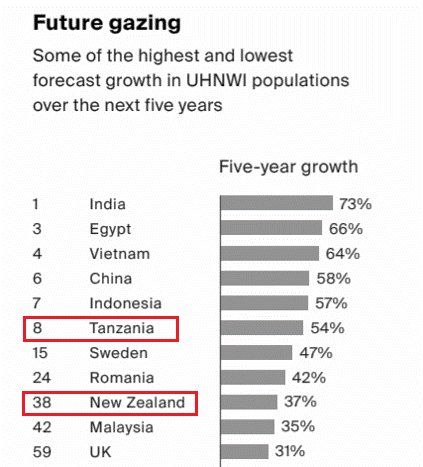
The Wealth Report 2020 shows that the number of high-net-worth individuals (HNWIs) from Tanzania with 1m USD rose from 5,1 to 5,5% within the last year. What is even more interesting is that the report forecasts that the number of Tanzanian ultra-high-net-worth individuals (UHNWIs) holding 30m USD or more, will grow by 54% over the next five years, after being at 114 in 2019. What can be expected is that these UHNWIs will invest their money into businesses, thus raising overall productivity in the city, which is also directly linked to a higher average salary that raises the purchasing power of the citizens.
This growth projection of UHNWIs even beats New Zealand´s 2020 forecast, making the market even more interesting for OCHO:
Market Size and Relevant Population Insights
To better understand our chances of success with our expansion plan, I analyzed provided data on Statista for the Confectionery Market in Tanzania. With a market volume of 163m USD (~270m NZD), Tanzania has listed number 121 the global market comparison while New Zealand placed number 58 with a total market volume of 899m USD (1,460m NZD), which is surprising when considering that New Zealand only has 8,3% of Tanzania´s population. This gives a first impression of low demand in the market.
A possible explanation for this, as Africa is known to be the world´s least urbanized country, could be that 57% of Tanzania´s population are located in tribes in rural areas and only 43% are urbanized. To put this insight into numbers: Dar Es Salaam as Africa´s fifth largest and Tanzania´s largest city only makes up for 9,7% of Tanzania´s total population.
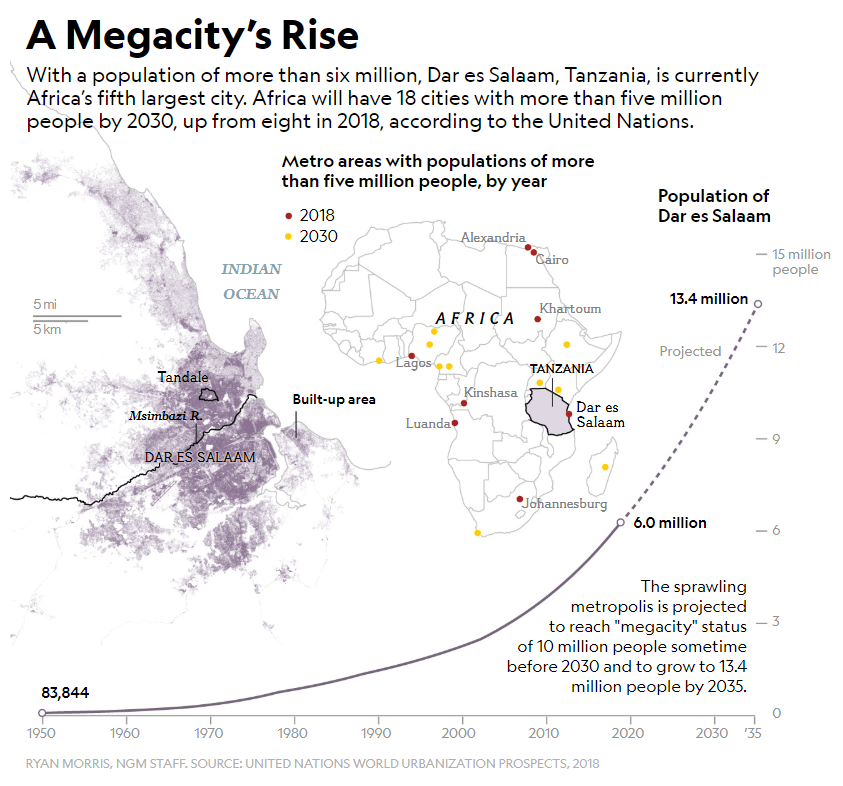
This percentage might not sound like it´s much, but in fact, Dar Es Salaam is the second-fastest-growing city worldwide and is forecasted to become one of the world´s most populous.
To get an idea of how extreme this growth actually is, have a look at this image that illustrates the city´s growth curve from the past 70 years with the projected numbers until 2030, indicating an exponential growth.
What do these differences in rural and urban population indicate for our project plan?
A study published in the journal Science indicates that tribes and rural living communities usually live off of food they find in the forest, such as wild meat, honey and wild berries. They do not eat processed food and have probably not even tried chocolate once in their lifetime, so their dietary habits can give insight into why the market volume is so low within the entire country. You can´t miss the taste of something you´ve never tried, right?
Either way, chocolate-eating habits are notably different in Tanzania´s urban areas, especially in our town of interest.
According to another study paper I analyzed, findings showed that 22% of children between 12-23 months in Dar Es Salaam consume candies or chocolates, and as the mother´s main reasons for the mother feeding this type of food to their child(ren) it was identified that because it is liked by the child (86,3%) and because it was demanded by the child (9,6%). What we can draw from these insights is that mothers care to buy chocolate for their children starting from a young age, which creates a preference and habit for them over time, making them potential customers for our cause.
Supply, Demand and Marketplace
But how exactly does the demand and support situation look like within the country?
In the previous section, we had already analyzed demand by domestic market volume, which showed positive indicators for expansion plans. The New Zealand Trade & Enterprise confirms that Tanzanian household consumption expenditure is increasing by more than 10% annually, which implies that demand for high-quality products is increasing – A development with positive indication for the potential success of our premium quality chocolate assortment.
As for demand in Dar Es Salaam, I suggest we put local demand on the list of topics to discuss with local store owners when meeting them for business purposes. I am confident that they will be able to provide insights into their chocolate sales numbers of the past years, which will enable us to make a future prognosis for success of our sales numbers.
On the supply side, I could identify the following companies that could be of strong competition to us:
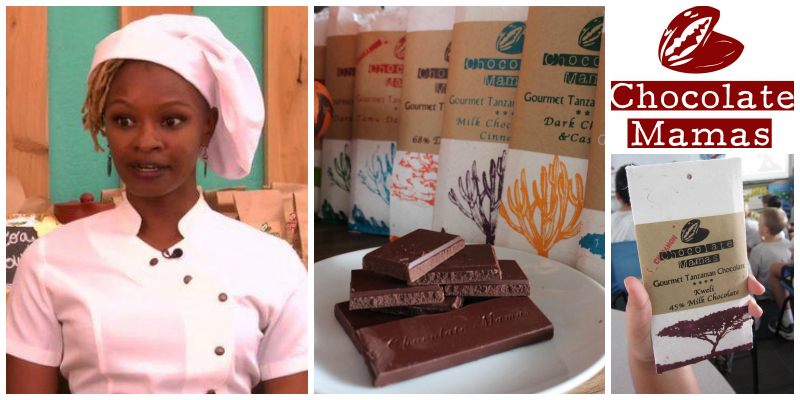
Chocolate Mamas Gourmet Tanzanian Chocolate Company from Dar Es Salaam is making big waves on the African continent as Tanzania´s first chocolate producer. Their premium-quality chocolate products are entirely processed in Tanzania, from bean selection and roasting to the final bar. Their competitive advantages include the support of local farmers with fair prices and cultural familiarity and understanding of the Tanzanian customer base due to being a local company founded by a native. Their product range consists of 13 variations of chocolate and is sold in various supermarkets, shopping centres and gift shops around the area of Dar Es Salaam. As of now, the company is only regionally active and does not have a website for e-commerce purposes. However, they are planning to expand into Europe and the U.S. in the future.
Other local competitors we should be taking into account are Karuna Chocolate and Aruntam Sensory Chocolate from Italy and Kaitxo from Spain, as they have been rewarded with Gold, Silver and Bronze for the Tanzanian chocolate market. This was decided by a national and regional representative jury as part of the International Chocolate Awards 2019.
Legal Requirements
Tanzania is currently politically stable with no history of civil wars, ethnical conflicts or internal uprising, which supports our cause as potential investors. The good news is that Tanzanian law offers protection of intellectual property rights, so it is imperative for us to register our trademark to protect the sovereignty of our brand in the market here.
However, just like many other countries, the Tanzanian governments put strict import regulations and procedures in place that need to be analyzed and followed before entering their market.
In order to be able to import our goods into Tanzania, our products will have to get examined and approved by the Tanzanian Food and Drugs Authority (TFDA) which governs overall food importation amongst other things. Any organization must register the business premise with the TFDA before commencing business operations within the country and obtain a business license for trading their products.
To achieve approval from the TFDA, I suggest we apply for a business permit first while simultaneously registering our products, then send an application for an import permit. The necessary forms for these steps can be found on the TFDA website here.
The import license is only given after regulated product controls, which aim to guarantee quality and safety of the food for Tanzanians and prevent the spreads of diseases and pests. An inspector will examine (and hopefully) approve before the distribution in the market. I have organized for a set of samples to be sent out to the TFDA mid-April for laboratory analysis to speed up the approval process. By doing so, I also wanted to make sure that we receive the approval before our trip there so that we have a license enabling us to bring along samples for our business partners.
Amongst the content and the quality of our products, they will also analyze whether our packages are compliant with their labeling requirements. I did check their General Standard Codex for the Labelling of Pre-Packaged Foods but could not find any requirement that our current package labels do not already contain.
In addition to regulational approval from TFDA, we will have to register OCHO as an importer of food with the Tanzania Bureau of Standards (TBS) here before our first import into the country.
As for the import procedure itself, we are required to follow important procedures for clearing the goods from customs control as per East Africa Community Customs Management Act (EACCMA). Importers are obligated to appoint a Licensed Clearing and Forwarding Agent (CFA) to clear the goods from the ships. A list of certified CFAs operating in Tanzania can be found here. The documentation process of the import is done digitally via Tanzania Customs Integrated System (TANCIS) and should be completed at least 7 days prior to the goods´ arrival. 18% VAT will be applied to the sale price of our imported goods.
 Investigating market opportunities in Tanzania for Ocho Chocolate Company