
We constantly hear about ambitious market entries by big companies taking a wrong turn. In fact, market experts say that according to business history reports, four out of five market entries fail. This fact underlines that market entries can be challenging, and while the market entry might seem viable on paper, several uncertain factors will influence the actual success of the entry. Overall, companies that are successful in their domestic market tend to find their way across the globe if they have an outstanding product, which OCHO definitely has. But the fact is, the more different the culture in the foreign market to the domestic market, the bigger the risk of developing a wrong market entry strategy, so planning this step will be crucial for OCHOs success or failure in the foreign market. A beneficial entry will require a thorough understanding of the market, its competitive and regulatory environment and its consumer behaviors.
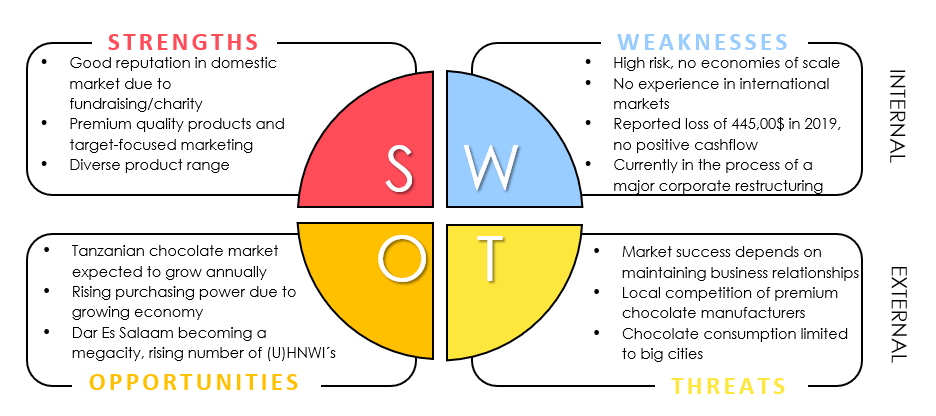
To prepare you for better understanding each entry mode´s benefits and disadvantages for OCHO, I gathered the most important points from the previous articles to create a SWOT analysis, which provides an overview of our company´s strengths and weaknesses relevant to the market and of the opportunities and threats the Tanzanian market offers.
Let us now try to decide on a well-thought-out market entry strategy based on the information we gathered.
The entry modes differ around the point of cost, risk and amount of control that remains to the entering company.
Analysis of Entry Modes
Direct / Indirect Exporting
Exporting is the fastest and most risk-free way to enter the Tanzanian marketplace and involves establishing a distributorship with a distributor or agent in Tanzania. This would enable us to draw advantage of their local knowledge, as they have the necessary experience for local distribution. However, we may lose control of the way our products are marketed and priced in the foreign market, which might negatively influence the outcome of our market entry and harm OCHO´s reputation. A thorough analysis of the distributor´s business objectives and its historic development is therefore indispensable. Please note that in Tanzania it is not rare that wholesalers are also operators of supermarket chains and shopping malls, so this might be a considerable option for us at a later point in time.
We may alternatively decide to directly export to consumers in Tanzania via e-commerce, which would enable us to build relationships with customers from our domestic base and maintain control over distribution. For this method to be taken into consideration, we should take into account the availability of internet access in Tanzania:
According to Reuters, the number of internet users in Tanzania rose up to 23 million in 2017, which amounts for around 41% of the population (from only 16% in the previous year), whereas around 82% of those internet users access the world wide web via their mobile phones. These numbers indicate that internet access for Tanzanians is rising exponentially, making e-commerce and direct marketing via web a considerable option for OCHO. If we decide on this option, I suggest we also consider creating a separate website for secure credentialing of our Tanzanian customers with a .co.tz ending. Please consider this a necessity, as credit card usage is still minimal within the country.
If we go with the exporting option, I recommend doing a combination of both direct and indirect exporting, as people are more likely to purchase online if they already got the chance to see, touch and taste the product beforehand.
This entry mode comes with some disadvantages that require consideration. For example, if our products do not get certified or licensed by the TFDA, this entry mode will not be an available option for OCHO, as TFDA approval is a requirement for import permission. Another negative aspect of the Exporting entry mode is that we will be faced with exchange rate fluctuations and trade barriers such as tariffs, as New Zealand has no free trade agreement with Tanzania.
Greenfield Venture
To have more control over the distribution process, we may look into establishing a corporate presence in Tanzania with a Greenfield Venture as a separate legal entity / subsidiary through the Business Registration and Licensing Agency (Brela). Brela approves registration of entities only if objectives are set in a compliant way with international reference classification of productive activities (ISIC), which allows providing a set of business activity categories that can be utilized for collection and reporting of such business activities. So as we can see, this entry mode requires a lot of bureaucracy costs and time to set up. It should further be considered that the income of our legal entity would be taxed 30% by the Tanzanian government.
Among all entry modes, this is the one that would grant us the most control at the Tanzanian market, but is that really wise? I strongly advise against this entry mode, as OCHO lacks the experience to get a positive outcome of this entry strategy and the cultural differences between our markets are simply too high to be pulling this off.
In addition, this mode entails a great amount of risk as we will be directly investing and committing to the Tanzanian market.
Acquisition
An Acquisition requires a similarly high investment as Greenfield Venture and would involve us gaining control over a Tanzanian company through purchasing the majority of their assets or ownership equity. This might have been an appealing entry mode for OCHO, as it allows quick access to a new market through a well established local company. Furthermore, it enables working with established operations the locals are familiar with. But since this procedure is very expensive and we do not possess the necessary resources, this strategy seems out of reach for OCHO.
Strategic Alliance
We may also consider entering the market through a Strategic Alliance with one or more Tanzanian companies. This is typically done with a contractual agreement and the main objective is to cooperate for a certain time in order to achieve common objectives while the partaking firms remain independent. This would enable us to preserve our autonomy while gaining advantages through the sharing of resources, thus reducing risk. It would also enable us to take advantage of our partner firm´s experience with the local culture, market and Tanzania´s way of doing business. If the partner is chosen wisely, we may also benefit from their existing relationships with local customers and in addition, being associated with a recognized, reputable brand name can certainly do no harm. Possible negative effects could be that integration problems between the two corporate cultures may occur (which is very likely given the big cultural differences) and that the required investment might be higher than the costs of exporting.

Joint Venture
Through the U.S. Foreign Commercial Service I found out that the Tanzanian government encourages Joint Ventures between foreign investors and local companies. A joint venture is a form of business organization that is set up by two or more companies for the purpose of achieving a particular task or project. This method entails the same benefits as a Strategic Alliance. Complimentary assets can benefit both sides and sharing objectives also entails sharing risks, rewards and regulatory requirements such as financial and insurance. However, some negative consequences of this method might be being bound to strict terms and conditions as well as possible conflicts between the two companies.
Another market entry possibility would usually be Franchising or Licensing. However, we will not be looking into these options as our CEO clarified that at this point in time, OCHO is not a mature enough company to be having proprietary assets given to independent business owners.
The Market Entry Suggestion
All facts considered, Exporting seems OCHO´s best go-to option for the Tanzanian Market Entry and its first sales. The main reason for this conclusion being that our company does not have enough funds or experience to be able to afford high-risks strategies on a foreign market as of now.
Any other entry method requires more investment, and as OCHO is still to recover from the losses of the past business years, we do not have the necessary positive cashflow to be investing large sums into a Greenfield Venture or an Acquisition.
Our first evident step on our business trip should be to ensure that our products are approved by the TFDA to make sure we have the legal green light for this entry mode. I will make sure to set up an appointment with the TFDA in our first week in Tanzania.
I am confident that during our business trip we will find suitable agents or distributors who will take care of exporting and promoting our products in the foreign market. In return, not being able to react to customer communications as quickly as we might be able to do by choosing another entry mode seems like a minor disadvantage that our company would be able to handle. Let us also bear in mind that the wholesaler, as well as retailer, would be adding a markup to the price of our product, so we need to prepared for negotiations during our business trip. For this, I already filed a request to HR to organize a professional negotiation training for my travel companion and me.
Once we decided on a wholesaler or agent, we should seek their advise on suitable overseas transport companies and request assistance in setting up special transportation conditions for our products. They need to be imported in cooling boxes to avoid melting under the heat of the African sun. At this point, I would like to point out that Dar Es Salaam handles 95% of Tanzania´s port traffic, so this harbor should definitely be chosen as the docking station for our imported products.
Furthermore, we should keep track of Market Challenges that we will be facing in Tanzania, including bureaucratic ´red tape´ and corruption, difficulties in enforcing contracts through local courts, underdeveloped transport systems, high interest rates and an infrastructure that is still in the process of being expanded.
The biggest risk is not taking any risk. In a world that’s changing really quickly, the only strategy that is guaranteed to fail is not taking risks.
MARK ZUCKERBERG, FOUNDER AND CEO OF FACEBOOK
 Investigating market opportunities in Tanzania for Ocho Chocolate Company