
Cultural norms play a significant role in interpersonal relationships inside the business world. When we grow up in a certain culture, we take behavioral norms of that society for granted and expect that this is the only ´right way´. But the truth is, there are no ´right´ or ´wrong´ cultural behaviors. We can not go to Tanzania and expect the locals to know about the way we do things or even expect them to act the same way. Our world is widely diverse. Understanding and accepting different ways of living and behaving can help us to grow beyond our horizons and to adapt our professional behavior, increasing the chances of closing successful business deals.
Before stepping into a foreign culture, a thorough analysis of cultural norms is required and by evaluating our approach, decisions and actions based on the sense of how the foreign society might feel about it can avoid causing any offense. In the end, being familiar with cultural differences between the foreign and domestic market and considering detected variances when developing market strategies is essential to a firm´s international success, especially for a firm with the size of ours.
To analyze the cultural differences that could lead to challenges of entering the Market, we will use the popular country comparison tool from Hofstede-Insights. This Europe-based consultancy provides valuable information on culture data from countries all around the globe that can help organizations manage cultural differences and overcome intercultural and organizational challenges.
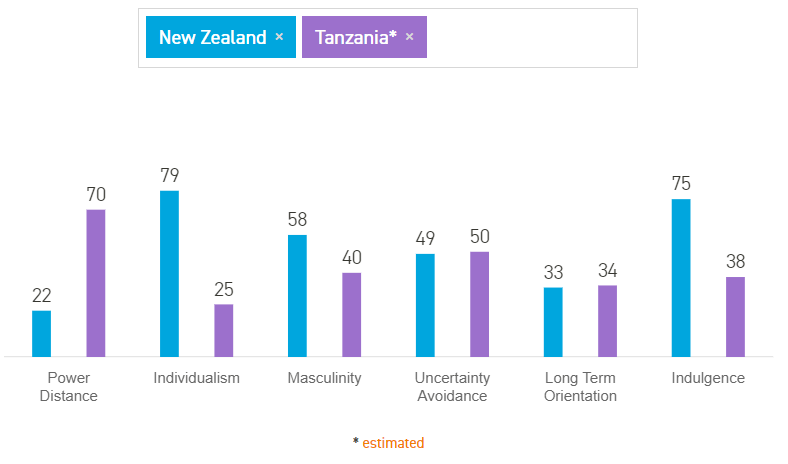
Let us make sure to take notice that the information about Tanzania is marked as estimated, signifying that the consultants providing the data did not conduct sufficient cultural observation to guarantee the legitimacy of the data. However, we will still compare the provided information to identify significant differences in cultural corner pillars and prepare our mindsets accordingly for our business trip.
The first major difference we identify between New Zealand and Tanzanian culture is the power distance allocation. While in our culture organizational hierarchy is just a formality and subordinates are seen as equal partners by their superiors, Tanzanians are hierarchy-oriented and stick to acceptance of strict role distributions.
So what exactly does this insight imply for us? We need to be aware that business is done differently in Tanzania. Business superiors will most likely make decisions without consulting with their subordinates beforehand, so we will need to invest our energy in finding ways to convince the person on top of the hierarchy. Recognizing and respecting the hierarchical order is essential, so at the beginning of business meetings, we should greet the person with the highest position first, then downwards according to position ranking.
In New Zealand, people are rather individualistic. We value our independence, focus on our own goals and needs and tend to place our self-interest over the collective interest in everyday life.
Tanzanian culture, however, is quite the opposite of ours. They are focused on the collective well-being of their society, consider the collective interest before acting and tend to stick with social norms and traditions to uphold social harmony. This insight will help us understand our potential customers and their purchasing motives better. For example, this suggests that locals will most likely show a higher likeliness of purchasing chocolate that was manufactured with ingredients from local farmers, as this local support will contribute to the overall economy of the country, thus creating a collective benefit.
We also note that masculinity dimension is slightly lower in Tanzania, which can be considered as an indicator that they have a higher preference for cooperation, modesty and flexibility and care more for the weak than we do in New Zealand. What this implies for us is that success in business with Tanzanian organizations is more likely to be achieved through negotiation and collaboration. In addition, they will put more value in the flexibility of their work environment, meaning they might re-schedule meetings shortly beforehand, ask for more flexible conditions in their contracts and have commitment issues.
As Uncertainty Avoidance and Long-term orientation are at the same level in both countries, we won´t analyze these dimensions.
However, we also note that there´s a significant difference in indulgence, indicating that New Zealand encourages free gratification of people´s individual drives and emotions, such as enjoyment in life, which underlines the individualist nature of our country that we analyzed in the first section. In Tanzania, however, there seems to be more emphasis on suppressing gratification and a higher focus on the regulation of people´s conduct and behavior with stricter social norms. This shows us that we should act according to general business codes of conduct, avoid talking about our private life and avoid making jokes when engaged in formal meetings.
Now that we have discussed subordinate differences and similarities between Tanzania and our home country, let us have a look at the challenges regarding the marketing of our product we might face due to the aspects we discussed when we created Tanzania´s cultural profile.
Languages – Due to Swahili being Tanzania´s national language and English only being used in some areas of every day life, OCHO might be facing communicational challenges in product packaging and communications. To overcome these difficulties, translations might have to be implemented. The language hurdle might also pose a challenge to overcome during our business trip and slow down our work. Please also bear in mind the literacy rates we analyzed in our second blog entry, so it might be beneficial to look into a more pictographic way of communicating with potential Tanzanian customers.
Color symbolism – The cultural profile underlines that Tanzanians tend to link colors to direct meanings. The implication I draw from these color symbolism patterns is that color decisions in our packaging and communication should be well-thought through.
Especially the color red seems to become problematic, as there are contradictive ways of association. To avoid creating the negative association, OCHO might want to consider staying away from this color.
As green could be falsely associated with medicine, this is a color that might not be the best choice for communicating the benefits of our product.
Colors we should look into are blue and black, as these seem to be most compliant with the value and purpose of our products.
Relationship with chocolate – For decades, the distinctive flavour of Tanzanian cocoa has been gaining attention from the international chocolate world. Cococa contributed to household income more than any other exported crops. While chocolate was perceived as casualty in many countries, journalists exposed the ongoing exploitation of African cocoa farms, where children were enslaved to harvest the crop and inhumane prices of 2$ per day were paid from international chocolate manufacturers. This was one of the reasons why Africans lived below the poverty line and could not afford to taste the outcome of the beans – until recently, with the rising economic growth of many African countries – including Tanzania. This historical development is still in the minds of Tanzanians. That combined with their national pride is the reason why they prefer consuming goods with ingredients that were sourced locally. They are looking to support their own country and its economic upturn, which underlines the insights of Tanzania´s ´independence´ dimension. This mindset might pose the biggest challenge for OCHO to overcome.
Obviously everyone is unique and this model and the cultural profile won´t apply to each and every single person within a culture. However, we can use insights from our analysis to make the unknown less intimidating, avoid mistakes that could harm our company´s reputation and provide a confidence-boost when meeting people in an unfamiliar country.
If you still feel a sense of uncertainty and would like to learn about Tanzanian culture tips from someone who experienced their culture live, I recommend watching this video:
 Investigating market opportunities in Tanzania for Ocho Chocolate Company